
House-number size is mainly a visibility problem. A set that looks large when you stand three feet from the wall can look surprisingly small from a moving car at the curb. The right size depends on viewing distance, contrast, placement and the surrounding environment.
Use Distance as Your First Filter
Viewing distance is one of the first factors to consider when choosing house-number size. Numbers mounted close to the sidewalk do not need to solve the same visibility problem as numbers mounted on a house set far back from the road.
As the viewing distance increases, larger characters generally become more useful. However, distance should be treated as a starting point rather than the only factor.
The angle from the road, vehicle speed, surrounding lighting and whether landscaping or parked cars partially block the address can all affect real-world visibility.
Contrast Can Matter as Much as Height
A large number can still be difficult to identify when its finish blends into the mounting surface. Dark numbers on dark brick or siding may lose definition, particularly from farther away.
Strong contrast between the numbers and the background can make the characters easier to distinguish during daylight. If the numbers are illuminated, consider how they look both when the lighting is on and when it is off.
Size and contrast should therefore be considered together rather than treating character height as the only measure of visibility.
Measure the Whole Address
Individual house numbers are often mounted separately. Several large digits can require considerably more horizontal room than expected once appropriate spacing is included.
Measure columns, trim, garage openings, wall edges and any nearby fixtures before choosing a size. This is especially important for four- and five-digit addresses.
Horizontal vs. Vertical Layouts
Horizontal layouts are generally straightforward to scan when there is enough wall width. Vertical layouts can be useful on narrow columns or other locations where horizontal space is limited.
However, the entire address should still be easy to understand quickly. Consider the direction from which most visitors and vehicles approach the property.
A layout that looks balanced when standing directly in front of the house may be less readable from an angled street approach.
Lighting Does Not Replace Proper Sizing
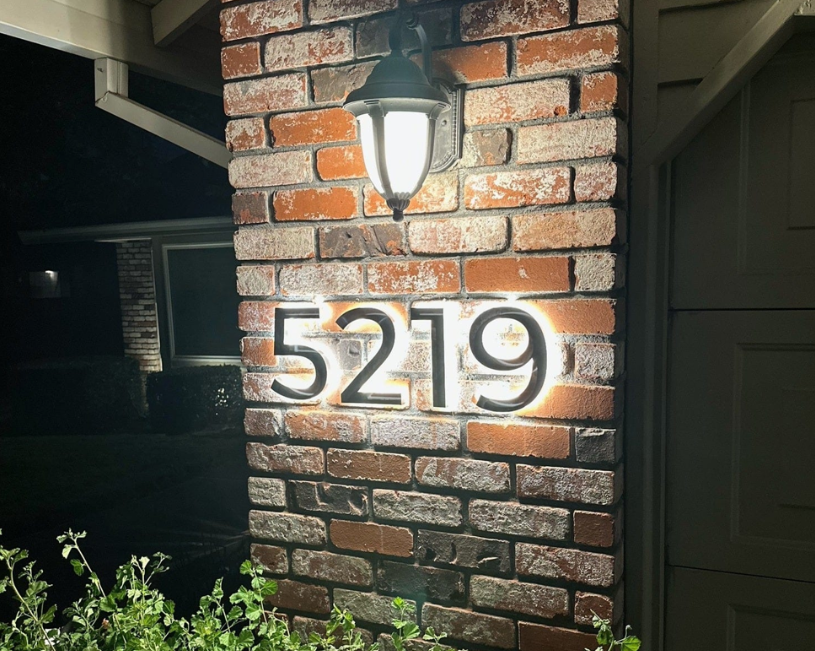
Illumination can improve nighttime visibility, but it cannot fully compensate for characters that are too small for the viewing distance.
Start with an appropriate physical size and good contrast. Then decide whether illumination would provide an additional benefit after dark.
If you decide illuminated numbers make sense, the next major question is how they will be powered. Our Solar vs. Hardwired Lighted House Numbers: Which Is Better? guide compares the main installation, reliability and maintenance trade-offs.
Placement Can Change the Size You Need
The same number size can perform very differently depending on where it is mounted. A clear wall facing the road may provide excellent visibility, while an address mounted behind a column or landscaping may remain difficult to see.
Before installing permanent numbers, look at the property from the normal approach direction during both daytime and nighttime conditions.
- Check whether trees or shrubs block part of the address.
- Consider whether parked vehicles could obstruct the viewing angle.
- Avoid placing the numbers where exterior fixtures create excessive glare.
- Check whether architectural features break up the outline of the digits.
- Make sure all digits remain visible from the intended approach.
Do Not Forget Local Requirements
Municipalities, homeowner associations and local emergency-address rules may specify minimum number dimensions, placement, contrast or other requirements.
Check the rules that apply to your property before treating general online recommendations as the final answer.
If a local requirement specifies a minimum character size or particular placement, that requirement should take priority over general buying advice.
What to Check Before Choosing a Size
- Distance between the street and the mounting location
- Normal direction from which vehicles approach the property
- Daytime contrast between the numbers and the wall
- Nighttime lighting conditions
- Available horizontal or vertical mounting space
- Potential obstructions such as plants, columns and parked vehicles
- Spacing required between individual digits
- Local municipality, HOA or emergency-address requirements
When Larger Numbers Make Sense
Larger numbers can be particularly useful when the home sits well back from the road, the address needs to be identified from a moving vehicle or the mounting location is partially obscured.
They may also help when the exterior uses visually busy materials such as patterned brick or stone, where smaller characters can become difficult to distinguish at a distance.
When Bigger Is Not Automatically Better
Increasing number size indefinitely is not always the best solution. Very large characters can overwhelm a narrow column, interfere with architectural trim or leave insufficient room between individual digits.
The goal is not simply to choose the largest number available. It is to choose a size that remains easy to identify from the required viewing distance while fitting the available mounting area correctly.
Daytime and Nighttime Visibility Are Different
An address that is easy to identify during the day can become much harder to locate after sunset. Conversely, illuminated numbers may look excellent at night but provide poor daytime contrast when their lighting is off.
If nighttime visibility is a problem, first confirm that the physical size and placement are appropriate. Then consider whether an illuminated design would improve the address without introducing unnecessary installation complexity.
For nighttime visibility, see Are Lighted House Numbers Worth It?
For choosing a power source, see Solar vs. Hardwired Lighted House Numbers .
For a broader overview of size, power and installation, read our complete lighted house number buying guide .
Need help choosing lighted address numbers?
Our complete guide covers number size, power choices, installation considerations and the other details worth checking before ordering.
View Lighted House Numbers Buying GuideQuick Questions
Are bigger house numbers always easier to see?
Larger characters can generally be easier to identify from greater distances, but size is not the only factor. Contrast, placement, spacing and obstructions can also have a major effect on readability.
Do lighted house numbers still need to be large?
Yes. Illumination can improve nighttime visibility, but the physical size still needs to be appropriate for the viewing distance. Lighting should complement proper sizing rather than replace it.
Does contrast really make a difference?
Yes. A number that blends into its background can be difficult to identify even when the character itself is relatively large. Consider the finish of the number against the wall or mounting plate.
Should I choose solar or hardwired illuminated numbers?
That depends on the installation location, available electrical power and sunlight exposure. See our solar vs. hardwired house-number guide for the main differences.
Should I check local requirements?
Yes. Local address-display requirements can differ, so verify any applicable municipality, HOA or emergency-address rules before purchasing or installing new numbers.
Final Verdict
The best house-number size is the one that remains easy to identify from the distance and angle where people actually need to see it. Character height matters, but contrast, spacing, placement and surrounding obstructions can be equally important.
Start by evaluating the street viewing distance and available mounting area. Then check daytime contrast and nighttime visibility before making the final choice.
If nighttime visibility remains a problem, read Are Lighted House Numbers Worth It? and compare solar and hardwired lighted house numbers before deciding how to illuminate the address.
You can also read our backlit vs. reflective house numbers guide for another comparison of nighttime visibility approaches.