
Solar and hardwired lighted house numbers solve the same basic problem in different ways: making an address easier to identify after dark. Solar models emphasize simpler installation, while hardwired systems prioritize a more consistent power source. The better choice depends on sunlight exposure, available wiring, installation difficulty and how important reliable nighttime illumination is for your property.
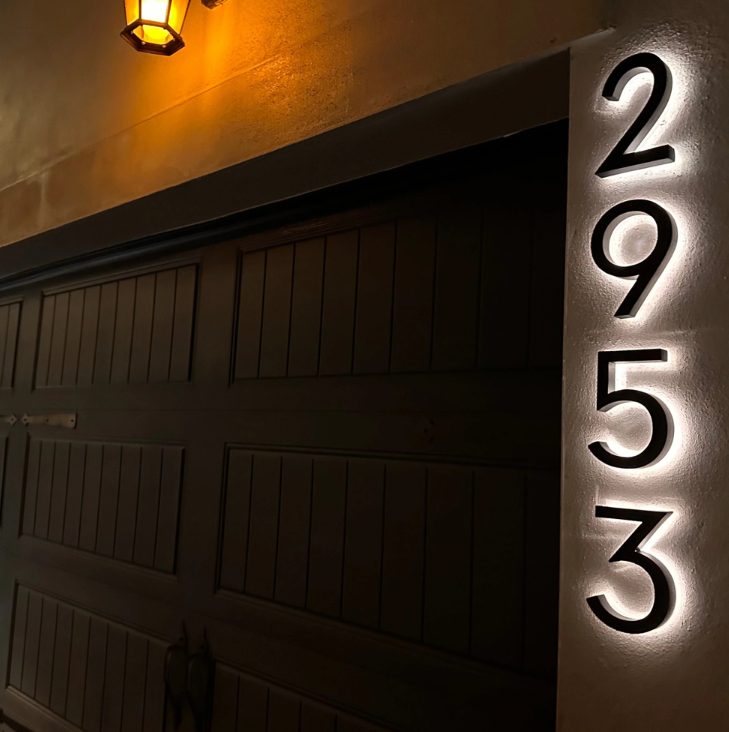
Solar vs. Hardwired: The Main Difference
The fundamental difference is where the lighting receives its power. Solar house numbers use a small solar panel to charge a battery during daylight, then use stored energy to illuminate the address after dark.
Hardwired lighted numbers receive power from an electrical connection. Depending on the product, this may involve low-voltage wiring, a transformer or another manufacturer-specified electrical setup.
| Factor | Solar | Hardwired |
|---|---|---|
| Power source | Solar panel and rechargeable battery | Electrical connection |
| Installation | Usually simpler | More involved |
| Sunlight dependency | Yes | No |
| Nighttime consistency | Depends on charging conditions | Generally more predictable with proper installation |
| Battery maintenance | May eventually require battery replacement | Usually no solar battery to maintain |
| Best fit | Sunny locations and easier installations | Permanent installations where reliable power is available |
When Solar Lighted House Numbers Make Sense
Solar designs are attractive when running electrical wiring to the mounting location would be inconvenient or unnecessarily expensive. Because the solar panel provides the charging source, installation can often be simpler.
This can make solar models appealing for fences, posts, detached structures and exterior walls where suitable electrical wiring is not already available.
However, the installation location needs adequate sunlight. A solar panel positioned under a deep porch, dense tree canopy or permanently shaded side of the building may not receive enough light to charge consistently.
Advantages of Solar House Numbers
- No direct household electrical connection for many designs
- Can simplify installation in suitable locations
- Useful where running new wiring would be inconvenient
- Automatic dusk-to-dawn operation is available on some designs
- Can work well for properties with good solar exposure
Limitations of Solar House Numbers
- Charging performance depends on sunlight exposure
- Shade, weather and panel orientation can affect available energy
- Rechargeable batteries can lose capacity over time
- Dirty solar panels can reduce charging performance
- Nighttime brightness or operating duration may vary with charging conditions
When Hardwired Lighted House Numbers Make Sense
Hardwired systems are worth considering when the installation is intended to be permanent and reliable electrical power is available at or near the mounting location.
Because they do not depend on daily solar charging, wired systems can provide more predictable illumination in shaded locations or properties where direct sunlight is limited.
The trade-off is installation complexity. Depending on the product and existing electrical setup, wiring may require more planning than installing a self-contained solar unit. Always follow the manufacturer’s electrical instructions and applicable local requirements.
Advantages of Hardwired House Numbers
- Not dependent on daily sunlight exposure
- More predictable power availability when correctly installed
- Suitable for shaded entrances and covered areas
- Can integrate well with permanent exterior installations
- No solar panel needs to be positioned for charging
Limitations of Hardwired House Numbers
- Installation is generally more involved
- May require access to appropriate electrical wiring
- Installation cost can be higher if new wiring is required
- Electrical work must follow manufacturer instructions and applicable requirements
- Changing the mounting location later may be less convenient
Sunlight Exposure Is the Key Solar Question
The most important question for a solar installation is not simply whether the property receives sunlight somewhere. The solar panel itself needs suitable exposure where the address system will actually be installed.
Look at the proposed mounting location at different times of day. Roof overhangs, neighboring buildings, trees and seasonal changes can all affect the amount of direct light reaching the panel.
- Check the mounting location during several parts of the day.
- Look for permanent shade from porches and roof overhangs.
- Consider whether trees will create heavier shade during other seasons.
- Check whether the solar panel can be positioned independently of the numbers.
- Read the manufacturer’s charging and placement requirements.
What About Cloudy Weather?
Solar systems can still collect energy under some less-than-ideal conditions, but available charging energy can be lower than under strong direct sunlight. Actual performance depends on the panel, battery, weather and product design.
For a property where reliable illumination every night is especially important, this variability should be considered before choosing solar solely because it appears easier to install.
Battery Maintenance
Solar house numbers typically depend on a rechargeable battery to store energy collected during the day. Rechargeable batteries do not last indefinitely, and their capacity can decline with age and environmental exposure.
Before buying, check whether the battery is replaceable and whether a suitable replacement is readily available. A system with a difficult-to-replace proprietary battery may be less convenient to own over the long term.
Hardwired Installation Considerations
For hardwired systems, check the electrical requirements before ordering. Do not assume every illuminated number set uses the same voltage or installation method.
Review the manufacturer’s instructions for the power supply, transformer requirements, wire routing and environmental protection. If the installation involves electrical work outside your experience, consider whether professional installation is appropriate.
Which Option Is Better for a Covered Porch?
A covered porch can be challenging for a solar system because the roof may prevent the solar panel from receiving adequate direct light.
If the panel can be positioned separately in a sunnier location, solar may still be practical depending on the product. Otherwise, a hardwired system may provide a more predictable solution for a heavily shaded entrance.
Which Option Is Better for a Fence or Mailbox Area?
Solar can be attractive for a fence, post or mailbox-area installation where electrical wiring is not readily available, provided the location receives sufficient sunlight.
The important consideration is whether the address remains visible from the street. A convenient mounting location is not useful if landscaping, parked vehicles or the viewing angle makes the numbers difficult to identify.
Brightness Is Not the Only Visibility Factor
Choosing the power source should come after solving the basic visibility problem. A brightly illuminated address can still be difficult to identify if the numbers are too small, poorly spaced or mounted where they are partially hidden.
For many properties, number size, contrast and placement have as much influence on readability as the lighting system itself.
If you have not chosen the physical dimensions yet, read What Size House Numbers Do You Need for Good Street Visibility? before deciding on the lighting technology.
Solar vs. Hardwired by Buyer Type
| Situation | Option to consider first | Why |
|---|---|---|
| Sunny location with no nearby wiring | Solar | Simpler installation may be the main advantage |
| Deeply shaded entrance | Hardwired | Does not depend on solar charging |
| Permanent new construction | Hardwired | Electrical planning can be incorporated into the project |
| Fence or detached post | Solar | Can avoid running electrical wiring if sunlight is adequate |
| Maximum nighttime consistency is important | Hardwired | Power is not dependent on daily charging conditions |
| Easy DIY-oriented installation is the priority | Solar | Many systems avoid direct electrical wiring |
Questions to Ask Before Buying
- Does the installation location receive enough sunlight for a solar panel?
- Is suitable electrical power already available nearby?
- How difficult would it be to route wiring to the mounting location?
- Is the solar battery replaceable?
- What weather protection does the manufacturer specify?
- Are the numbers large enough for the street viewing distance?
- Will landscaping or parked vehicles block the address?
- Are there applicable local address-display or electrical requirements?
To decide whether illuminated numbers are worthwhile in the first place, read Are Lighted House Numbers Worth It? What to Know Before Buying .
To choose the physical dimensions, read What Size House Numbers Do You Need for Good Street Visibility? .
For the broader buying process, see our complete lighted house numbers size, power and installation guide .
Choosing a complete lighted house-number setup?
Our full buying guide covers number size, power source, visibility, mounting and installation considerations in one place.
View Complete Buying GuideQuick Questions
Are solar house numbers better than hardwired ones?
Not universally. Solar systems can be easier to install where sunlight is adequate, while hardwired systems can provide more predictable power in shaded locations. The better choice depends on the property.
Do solar house numbers work in shade?
Performance depends on the product and the amount of light reaching its solar panel. A heavily shaded location can make charging less reliable, so check the manufacturer’s placement requirements before purchasing.
Do hardwired house numbers require an electrician?
That depends on the product, installation and applicable electrical requirements. Review the manufacturer’s instructions first. If the required electrical work is outside your experience, professional installation may be appropriate.
Do illuminated house numbers still need to be large?
Yes. Lighting helps with nighttime visibility, but number size, contrast and placement remain important. See our house-number sizing guide for more detail.
Are lighted house numbers worth buying?
They can be useful when nighttime address visibility is poor, but they are not necessary for every property. Read our lighted house-number visibility guide to evaluate whether illumination solves a real problem for your home.
Final Verdict
Choose solar lighted house numbers when the installation location receives suitable sunlight and avoiding new electrical wiring is a major advantage. Solar can be particularly convenient for detached mounting locations where running power would be difficult.
Choose hardwired lighted house numbers when consistent nighttime power is more important, the installation is heavily shaded or appropriate electrical power is already available. The additional installation work may be worthwhile for a permanent setup.
Whichever power source you choose, solve the visibility problem first. Check house-number size and street visibility and read whether lighted house numbers are worthwhile before making the final purchase.
For a complete overview, continue with our How to Choose Lighted House Numbers: Size, Power & Installation Guide .